Friday, 13 April 2012

Failure or Portent


North Korea Rocket: Success is less important than the launch
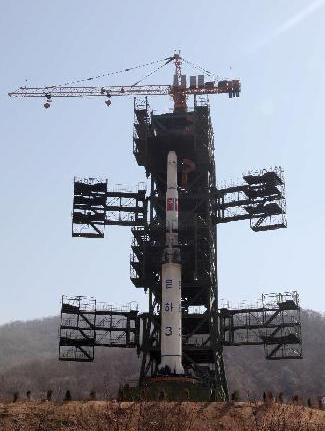


Photo (8/4/2012) shows the rocket for launching Kwangmyongsong-3 satellite installed on the launch pad in Tongchang-ri base. [Xinhua] 

The much publicised launch (and subsequent failure) of the 90 tonne Unha-3 rocket from the Tongchan-ri missile base on the western coast near the city of Sinuiju by North Korea (reported by space-travel.com) lays open one of the key issues within the realm of Space Law: what to do with a rogue state that is intent on pursuing an aggressive space programme? 

Space Law & International Law Issues


Clearly the international community view the North Korean rocket launch as having little to do with a spirit of scientific exploration and more to do with the development of a delivery system for tactical nuclear weapons. Viewed in this light the launch can be seen as a violation of UN Resolution 1874. This resolution, by virtue of Chapter VII of the UN Charter, and taking measures under its Art. 41 decides inter alia that North Korea shall "shall suspend all activities related to its ballistic missile programme and in this context re-establish its pre-existing commitments to a moratorium on missile launches". According to expressbuzz.com, to counter this, North Korea has claimed that the launch was for peaceful purposes and that the rocket-mounted satellite is to mark the birth centennial April 15 of the country's founding father Kim Il-sung.

Space Law & Space Reality


The launch has been condemned by near neighbours South Korea and Japan. Even China, the most significant ally of North Korea urged restraint "from all sides". The United States, in the form of White House Press Secretary Jay Carney released a statement condemning the launch as "provocative" and "a clear breach of international law". Whilst presumably the "international law" contravened was the above mentioned UN resolution 1874, the reality is that no substantive action will result from this launch. What is clear, given the rhetoric used, is that any new discussions on the North Korean nuclear programme remain a distant prospect.

For the North Korean government, the success of the Unha-3 rocket is not, therefore able to be measured in technological terms. Despite claims to the contrary, there is no independently verifiable evidence that North Korea has managed to deploy any satellites in orbit. The Unha-3 rocket broke up after only one minute of flight, travelled 70 miles and didn't even make it to staging. As has been pointed out by U.S. Security Officials, this rocket launch was less successful than the launch of the Kwangmyongsong-2 rocket, which was launched in 2009 and travelled approximately 2,000 miles.

What the launch does demonstrate, however, is that despite the death of the dictator Kim Jong-il in December 2011, North Korea remains committed to an aggressive military programme and in particular the development of a ballistic missile system. International and Space Lawyers are once again forced to contemplate the impotence of existing legal frameworks to combat a rogue nation which decides to deploy space technology in furtherance of military aims.

Thursday, 12 April 2012

First Flight...


It seems appropriate that I should start writing the first blog post today, 12th April 2012, 51 years after Yuri Gagrin's first orbit of the Earth heralded the start of humanity's exploration of the space beyond their own planet. This blog hopes to provide regular updates on all issues surrounding the legal aspects of space exploration.

What is Space Law?


In this blog, I will be writing about what exactly "Space Law" is and the nature of some of the issues that a lawyer will face when dealing with extra-terrestrial cases together with the political developments that will have both a direct and indirect influence on Space exploration. These issues comprise regulation of commercial activities, military uses of space, the exploitation of other celestial bodies and also space tourism, with the prospect of increased numbers of space travellers. In reality, "Space Law" is a catch-all term that covers the regulation of human behaviour beyond the boundaries of the earth and as such encompasses contract law, tortious law and even criminal law. This blog will try and map the development of the emerging law relating to extra-terrestrial activities and hopefully provide some relevant comment and analysis. 

Theories of Space Law


The blog will also look to explore the underlying philosophy as to what Space Law should be as well as what it is. These jurisprudential theories are somewhat overlooked in Space Law, which remains largely doctrinal in its approach. The law we export beyond the planet, however, needs to be viewed as more then mere regulatory mechanisms. More than any other form of law, Space Law operates on a transnational and international canvas - this blog will seek to explore how this international dimension impacts upon the legal frameworks that are developing and that are yet to develop. This blog does not seek to provide the definitive position on such issues, rather serve as a starting point from which the debates and ideas can blossom. 

The main focus of this blog will, therefore, be upon legal aspects to space exploration, however it will also seek to keep you updated about general issues from the whole area of space travel. My training (and expertise) is from a legal academic point of view but my interests span the scientific, technical and political dimensions of space exploration and I hope to share with you not only the current issues but also future developments and those projects and ideas that foster the rêve des étoiles, a dream which drives humanity beyond its current boundaries.

Coming Soon: Thoughts on "The Outer Space Treaty"


The next blog post will examine exactly what we mean by Space Law, this will encompass a nod to the work of Professor Bin Cheng, one of the founding fathers of Space Law and an examination of the work of the United Nations Committee on the Peaceful Uses of Outer Space (COPUOS). Most of what is understood to be "Space Law" stems from the five treaties negotiated within this committee including the seminal "Treaty on Principles Governing the Activities of States in the Exploration and Use of Outer Space including the Moon and other Celestial Bodies" - more commonly referred to as "The Outer Space Treaty". The OST is regarded by many academics as the "Magna Carta" of Space Law and no serious Space Law discussion can occur without reference to this treaty. Full details of the treaty can be found on  the United Nations Office for Outer Space Website website here.

In the meantime, to celebrate Yuri's Night here is a short documentary made about that historic and inspiring 90 minute voyage;


At a time when the world appears to be an increasingly uncertain place, when optimism is low and society seems fractured and intent on discussing differences, I wish you a "Happy Yuri's Night" with all of the hope and excitement that such an anniversary offers.